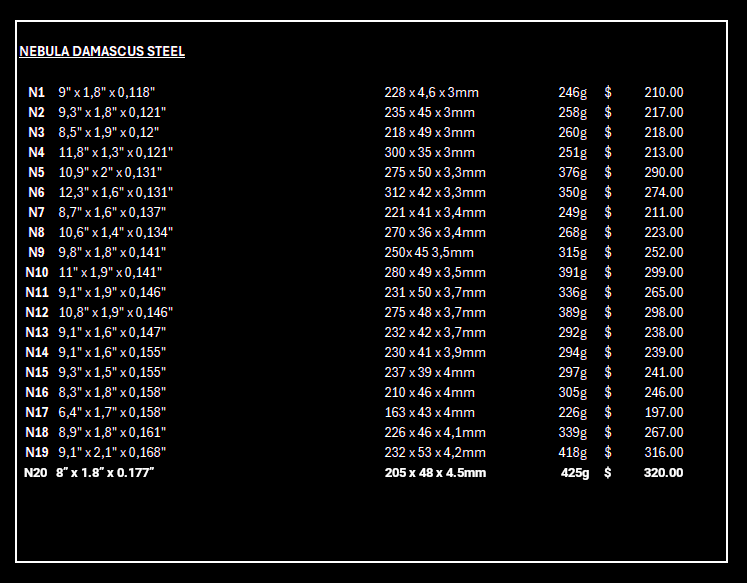
Nebula Damascus steel
Here is a list of Nebula Damascus steel that is available immediately. The price INCLUDES shipping with DHL courier delivery to your door anywhere in the world.
Please E-mail me with the number of the bar you would like to purchase: bertie@rietveldknives.com
Paypal is accepted
If you want a specific bar that is not on the list, mail me and I can make it for you, takes around a week.


Copyright © 1999 - 2024 Bertie Rietveld - Distinctive Knife Creations
Heat Treatment and colouring of Nebula Damascus
Heat Treatment
Before heat treatment, make sure the blades are straight. This is important, because heat treatment does not straighten blades for you!
Preheat Furnace to 900-950° C (1652-1742° F), place blade in and when furnace is back to temp remove quickly and quench in medium or fast quenching oil. For best results limit the time the blade spends at this high temperature. It is a basic carbon steel and does not require soaking at temp. If your oil is right next to your furnace, 900ºC should be fine, otherwise go with 950. If you can coat the blades with Condursal or similar product. What works really well too is to spray the blade with high heat rattlecan paint, I use Rust-O-Leum. My blades spend less than 10 minutes in total in the furnace you can also place a charcoal briquette in the bottom of the furnace to burn up the oxygen. Do not use foil packets as this takes too long to remove, you need to be quick with the quenching.
You can vary the depth of the blade in the oil when quenching but do not move it sideways as cold oil comes into contact with one side of the blade and will surely warp it.
Temper at 200° C (392° F) for 30 minutes.
Nebula is quite stable and should not warp but……
If the steel should warp during heat treatment, anneal, straighten and re-treat, but it would probably affect the steel’s quality.
Anneal by heating to 650–700ºC (1202-1292° F) and cool slowly by inserting blade in a container of vermiculite to cool.
Or you can heat the spine slightly with a small torch and straighten….very carefully! This may leave a mark when you colour the blade as the heating with a torch alters the structure of the steel.
Layout of blades on the bar of steel and some other tips.
As the Nebula bars are forged and not rolled like conventional steel, here are some tips to ensure you get the most out of the steel:
Always position the blade so that the cutting edge is as far from the sides as possible.
Always position the blade so that the back end of the blade corresponds with the end of the bar, tip facing inwards.
Leave cutting edges about 1mm thick before heat treatment, and final grind afterwards being careful not to overheat the edge.
Colouring
This process is basically the same as other hot bluing processes in that you need a stainless tank with a gas (propane) burner underneath to heat it to the desired temp. and an accurate thermometer to monitor the emp.
The following chemicals are needed :
• Sodium Hydroxide 2500g (caustic soda)
• Sodium Nitrate 500g
• Sodium Nitrite 120g
• Trisodium Phosphate 60g
• Water 5 litres
You can dissolve the solids in the water. You might need to make the recipe 2 or 3 times to suit the tank. Add chemicals slowly as the mix heats up considerably. Remember to make the tank sides quite high so that f the solution boils (and sometimes foams) it does not overflow. Mark the original level of the tank so in future you can add water to that level before starting, as it boils off in the process.
When hanging the work piece in the tank, I usually do so with stainless wire, (TIG welding wire) so that the blade hangs free, not touching sides or bottom and move the blade position in the tank from time to time to avoid one side colouring differently from the other due to varying temps in the bath.
I usually start heating the tank and hang the work piece in at around 100°C (212F) and boiling starts around 110°C(230F) to 120°C(248F)(you might need to add water if the boiling temp is above this, but do so very carefully as the bath temp is above the boiling point of water and it might react violently –add water slowly! Once boiling starts, keep close tabs on the colouring by removing work piece from tank and inspecting. The colours will start happening around 120°-130°C.(248-266F). This steel has a special affinity for colour and very nice colours can be achieved with some patience. Once through the colour spectrum the steel will turn dark blue and then black, finally the blade will turn brown with rust. After you have the desired colour, rinse under running water and spray with a diluted vinegar solution and rinse again. Dry and apply a good quality gun oil or Q20 or other penetrating oil.
I have found the best surface finish before colouring to be a fine satin finish 1200grit. Another nice effect is to etch the steel quite deep with ferric chloride so that the nickel is a bit proud, this gives quite a durable finish, although don’t expect colours, it will go black.
When finished, close tank up properly as dogs might try to drink the water and get very nasty caustic burns as a result. Also be very careful as the solution is a very highly concentrated alkaline and can cause serious burns. Always wear a face shield and a respirator and rubber gloves. Also bear in mind that structurally the steel is not as strong as layered Damascus so be careful with thin blades that have delicate points. Best to avoid such designs.
DISCLAIMER
The chemicals and the process above is DANGEROUS and need to be handled carefully. Always use a full face shield and rubber gloves when working with chemicals and if you are not familiar with the chemicals, their properties and the safety rules to be followed when using the chemicals needed, do not attempt to perform the process above and rather give your blade to a gunsmith to colour for you. Bertie Rietveld can in no way be held responsible for any accidents or injury or loss you might incur by using and of the chemicals or following the instructions above.
Before heat treatment, make sure the blades are straight. This is important, because heat treatment does not straighten blades for you!
Preheat Furnace to 900-950° C (1652-1742° F), place blade in and when furnace is back to temp remove quickly and quench in medium or fast quenching oil. For best results limit the time the blade spends at this high temperature. It is a basic carbon steel and does not require soaking at temp. If your oil is right next to your furnace, 900ºC should be fine, otherwise go with 950. If you can coat the blades with Condursal or similar product. What works really well too is to spray the blade with high heat rattlecan paint, I use Rust-O-Leum. My blades spend less than 10 minutes in total in the furnace you can also place a charcoal briquette in the bottom of the furnace to burn up the oxygen. Do not use foil packets as this takes too long to remove, you need to be quick with the quenching.
You can vary the depth of the blade in the oil when quenching but do not move it sideways as cold oil comes into contact with one side of the blade and will surely warp it.
Temper at 200° C (392° F) for 30 minutes.
Nebula is quite stable and should not warp but……
If the steel should warp during heat treatment, anneal, straighten and re-treat, but it would probably affect the steel’s quality.
Anneal by heating to 650–700ºC (1202-1292° F) and cool slowly by inserting blade in a container of vermiculite to cool.
Or you can heat the spine slightly with a small torch and straighten….very carefully! This may leave a mark when you colour the blade as the heating with a torch alters the structure of the steel.
Layout of blades on the bar of steel and some other tips.
As the Nebula bars are forged and not rolled like conventional steel, here are some tips to ensure you get the most out of the steel:
Always position the blade so that the cutting edge is as far from the sides as possible.
Always position the blade so that the back end of the blade corresponds with the end of the bar, tip facing inwards.
Leave cutting edges about 1mm thick before heat treatment, and final grind afterwards being careful not to overheat the edge.
Colouring
This process is basically the same as other hot bluing processes in that you need a stainless tank with a gas (propane) burner underneath to heat it to the desired temp. and an accurate thermometer to monitor the emp.
The following chemicals are needed :
• Sodium Hydroxide 2500g (caustic soda)
• Sodium Nitrate 500g
• Sodium Nitrite 120g
• Trisodium Phosphate 60g
• Water 5 litres
You can dissolve the solids in the water. You might need to make the recipe 2 or 3 times to suit the tank. Add chemicals slowly as the mix heats up considerably. Remember to make the tank sides quite high so that f the solution boils (and sometimes foams) it does not overflow. Mark the original level of the tank so in future you can add water to that level before starting, as it boils off in the process.
When hanging the work piece in the tank, I usually do so with stainless wire, (TIG welding wire) so that the blade hangs free, not touching sides or bottom and move the blade position in the tank from time to time to avoid one side colouring differently from the other due to varying temps in the bath.
I usually start heating the tank and hang the work piece in at around 100°C (212F) and boiling starts around 110°C(230F) to 120°C(248F)(you might need to add water if the boiling temp is above this, but do so very carefully as the bath temp is above the boiling point of water and it might react violently –add water slowly! Once boiling starts, keep close tabs on the colouring by removing work piece from tank and inspecting. The colours will start happening around 120°-130°C.(248-266F). This steel has a special affinity for colour and very nice colours can be achieved with some patience. Once through the colour spectrum the steel will turn dark blue and then black, finally the blade will turn brown with rust. After you have the desired colour, rinse under running water and spray with a diluted vinegar solution and rinse again. Dry and apply a good quality gun oil or Q20 or other penetrating oil.
I have found the best surface finish before colouring to be a fine satin finish 1200grit. Another nice effect is to etch the steel quite deep with ferric chloride so that the nickel is a bit proud, this gives quite a durable finish, although don’t expect colours, it will go black.
When finished, close tank up properly as dogs might try to drink the water and get very nasty caustic burns as a result. Also be very careful as the solution is a very highly concentrated alkaline and can cause serious burns. Always wear a face shield and a respirator and rubber gloves. Also bear in mind that structurally the steel is not as strong as layered Damascus so be careful with thin blades that have delicate points. Best to avoid such designs.
DISCLAIMER
The chemicals and the process above is DANGEROUS and need to be handled carefully. Always use a full face shield and rubber gloves when working with chemicals and if you are not familiar with the chemicals, their properties and the safety rules to be followed when using the chemicals needed, do not attempt to perform the process above and rather give your blade to a gunsmith to colour for you. Bertie Rietveld can in no way be held responsible for any accidents or injury or loss you might incur by using and of the chemicals or following the instructions above.